
My sister has always had a habit of bringing home unusual things she finds at work. Most of the time, it’s something harmless—a misplaced trinket, an odd piece of packaging, or a gadget nobody can identify.
But one rainy evening, she walked into my apartment carrying something that instantly made my stomach drop.
She held it out in her palm, her face pale. “What is this?” she whispered.
It looked like a bone. A small, curved, slightly yellowed bone. It was about two inches long, with a joint at one end and a smooth, polished surface. It looked disturbingly like something that might belong to a finger. Or a toe. Or something else I didn’t want to think about.
My sister worked in a retail store. An old building. The kind with creaky floors and dusty corners and decades of forgotten history.
She’d found it on the floor, near the back stockroom. Just lying there. No explanation. No context. Just a creepy little bone waiting to be discovered.
For the next three hours, we became amateur forensic anthropologists. We googled. We took photos. We sent them to friends. We convinced ourselves it was anything from a raccoon bone to a human finger to a prop from a Halloween decoration that had fallen out of a costume.
The answer, when it finally came, was so absurdly simple that we both burst out laughing.
But before I reveal what it was, let me talk about a different kind of household horror: maggots in your trash bin. Because, as it turns out, that creepy bone story has a surprising connection.
Part One: How to Stop Maggots From Taking Over Your Trash Bin
Let’s start with the practical problem.
Why Maggots Appear (The Gross Science)
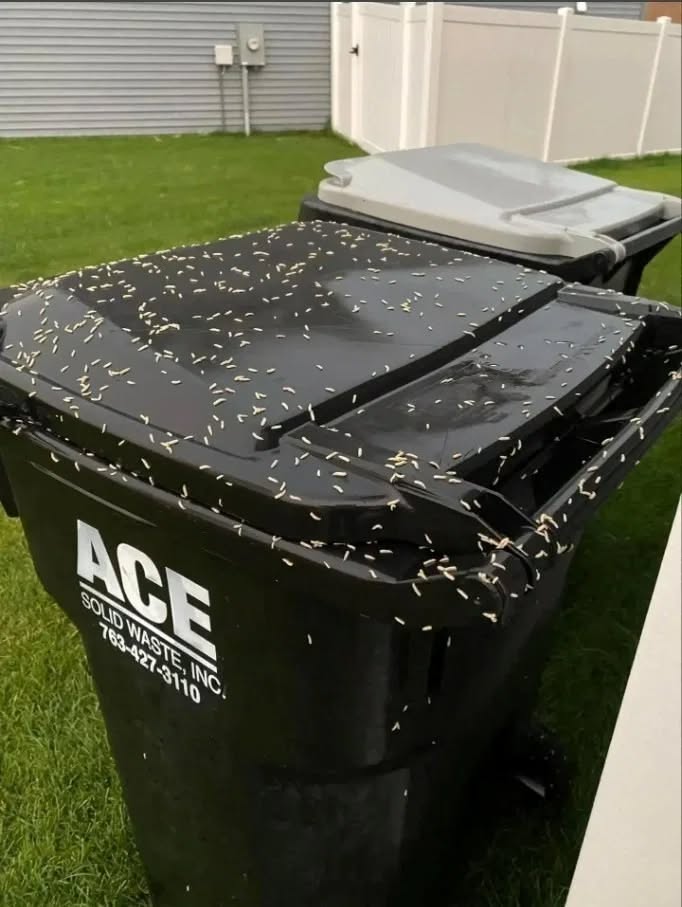
Maggots are fly larvae. Flies lay eggs in warm, moist, organic material. Your trash bin—especially in summer—is a five-star resort for flies.
The life cycle:
Fly lays 100-200 eggs (they hatch in 8-24 hours)
Maggots emerge and feed for 3-5 days
Maggots pupate (become cocoons)
Adult flies emerge (5-7 days later)
The result: One forgotten piece of meat or overripe fruit can lead to hundreds of maggots within days.
How to Prevent Maggots (Before They Appear)
1. Take out the trash frequently. Don’t let garbage sit for more than 2-3 days, especially in warm weather.
2. Bag your food waste. Double-bag meat, fish, and dairy scraps. Tie bags tightly.
3. Freeze smelly scraps. Keep a bag of meat, fish, and bones in your freezer until trash day.
4. Rinse food containers. Cans, jars, and takeout containers should be rinsed before tossing.
5. Use a trash bin with a tight-fitting lid. No lid = open invitation.
6. Clean your bin regularly. Every few weeks, hose out your bin. Scrub with hot soapy water. Disinfect with bleach or vinegar.
7. Sprinkle baking soda or diatomaceous earth. Both absorb moisture and deter fly eggs.
8. Keep your bin in the shade. Flies prefer warm, sunny spots. A shaded bin is less attractive.
How to Eliminate Maggots (If They’ve Already Arrived)
Step 1: Don’t panic. Maggots are disgusting but not dangerous to healthy people (they don’t bite or spread disease directly, though they indicate unsanitary conditions).
Step 2: Take the bin outside. Away from your house.
Step 3: Empty the bin completely. Dispose of the trash bag in a sealed container.
Step 4: Boil a large pot of water. Pour it directly over the maggots. They will die instantly.
Step 5: Scrub the bin with hot soapy water. Use a long-handled brush to reach all corners.
Step 6: Rinse with a mixture of 1 part bleach to 10 parts water. Let sit for 10 minutes.
Step 7: Rinse again with plain water. Dry completely.
Step 8: Line the bin with a new bag. Sprinkle baking soda or diatomaceous earth at the bottom.
What NOT to Do
Don’t use insecticide inside your trash bin (you’ll contaminate your trash and potentially harm animals that get into it).
Don’t use bleach on the maggots without boiling water first (bleach alone may not kill them quickly).
Don’t ignore the problem (maggots will pupate into flies, and the cycle continues).
Part Two: The Creepy “Bone” Mystery (What It Really Was)
Now, back to the bone.
The Discovery
My sister found it on the floor near the back stockroom. It was small, curved, and unmistakably bone-like. She picked it up with a paper towel (smart move) and brought it to my apartment.
We spent the next few hours in a state of escalating panic.
Our theories (in order of plausibility):
Animal bone (raccoon, squirrel, bird)
Human finger bone (because we have active imaginations)
ADVERTISEMENT
